Friday, 23 March 2018
Kitchen
Why get new kitchen cupboards when you can just paint your old ones. The paint is very robust and is similar to 'hammerite' in application. No brush strokes can be seen.
Saturday, 17 March 2018
Solar PV
The case for PV solar panels on your home:
PV solar panels produce electricity which you can either use yourself or export to the national grid.
In 2011 you could get 40p for every Kwh you produced from solar panels fitted to your home.
In 2018 it's 4p for every Kwh you produce and a further 5p for every Kwh you export to the grid.
These payments are referred to as FIT (Feed In Tariffs).
At first glance you'd think it's hardly worth getting them fitted nowadays.
However:
We had 10 x 0.295 kwh panels fitted. So, on a sunny day they can produce 2.95 kwh.
It's estimated that in a year we would produce 2579 kwh.
2579 X 4p = £103
It is deemed that we would export 50% of this to the grid and use 50% ourselves.
The equipment installed can't actually measure what is being used or exported, the FIT is based on the the assumption that we would export 50%, and the FIT payment to us is based on this.
So 1/2 of 2579 X 5p = £65.
A total income through FIT of £168 per year. Not a huge amount - but the key point is:
Any of the electricity we use, of that we are producing during the day, is free to us. So the electricity used to do the washing, or heating water etc etc during the day when we are producing electricity from our panels costs us nothing.
It is assumed we would make a saving of £144 in the year.
I personally think it will be much higher, as we are totally electric - water heating, space heating etc is all using electricity. I think the figure will turn out to be nearer £160+
The system cost £6050 to fit.
In a year the panels create £144 + £168 = £312.
If I keep the £6050 in the building society I'm lucky if I can get 2% on the investment.
By investing the money in solar PV I'm effectively getting a minimum of 5.1% .
It is as they say a 'no brainer'.
Additionally, the panels will increase the value of the house.
It also feels quite nice to be producing and using electricity that is less polluting in the long run.
Further details:
PV solar panels produce electricity which you can either use yourself or export to the national grid.
In 2011 you could get 40p for every Kwh you produced from solar panels fitted to your home.
In 2018 it's 4p for every Kwh you produce and a further 5p for every Kwh you export to the grid.
These payments are referred to as FIT (Feed In Tariffs).
At first glance you'd think it's hardly worth getting them fitted nowadays.
However:
- PV solar panels have come down in price hugely
- If you can use a lot of the electricity you generate then your bills will be reduced significantly
- If you have a small pot of money languishing in a building society somewhere that you are using to generate a small income from (interest) then the investment is better off on your roof
- PV solar panels (that you own) can increase the value of your property
We had 10 x 0.295 kwh panels fitted. So, on a sunny day they can produce 2.95 kwh.
It's estimated that in a year we would produce 2579 kwh.
2579 X 4p = £103
It is deemed that we would export 50% of this to the grid and use 50% ourselves.
The equipment installed can't actually measure what is being used or exported, the FIT is based on the the assumption that we would export 50%, and the FIT payment to us is based on this.
So 1/2 of 2579 X 5p = £65.
A total income through FIT of £168 per year. Not a huge amount - but the key point is:
Any of the electricity we use, of that we are producing during the day, is free to us. So the electricity used to do the washing, or heating water etc etc during the day when we are producing electricity from our panels costs us nothing.
It is assumed we would make a saving of £144 in the year.
I personally think it will be much higher, as we are totally electric - water heating, space heating etc is all using electricity. I think the figure will turn out to be nearer £160+
The system cost £6050 to fit.
In a year the panels create £144 + £168 = £312.
If I keep the £6050 in the building society I'm lucky if I can get 2% on the investment.
By investing the money in solar PV I'm effectively getting a minimum of 5.1% .
It is as they say a 'no brainer'.
Additionally, the panels will increase the value of the house.
It also feels quite nice to be producing and using electricity that is less polluting in the long run.
Further details:
- Our system was fitted by EON. The cost stated above includes everything - fitting of panels, erecting scaffolding, providing all monitoring equipment etc
- We chose an expensive system with higher output panels and a long life inverter. You can get a similar but cheaper system for around £4300.
- The system we bought is particularly good if a shadow falls on any of the panels - in simple systems if you get a shadow on one panel the whole array will not produce any electricity. We have a cheeky telegraph pole that casts a shadow on the roof for part of the day.
- Our inverter is said to have a life of 20 years - cheaper ones only 5 years
- Using the electricity you produce is the key to getting maximum value from the panels - could you heat a hot tub, charge your electric car?
- The system we have - Solar Edge - comes with a smart phone 'app' that tells you how much electricity you are producing, how much of it you are using and also shows your total electricity consumption - all in a nice little graph. It shows all this for each day, or week, or month or the year. Great for 'technogeeks' like me. In the screen shot below you can see that as it was a cloudy day we were only producing 300w and using 3.14 kw from the grid.
- Very soon it will be worthwhile getting batteries to go with a PV array. This will mean being able to store electricity produced during the day and then using it to run appliances at night time or when there is no light. Lithium Titanite is on the way. These are very safe (unlike lithium ion), can charge very quickly and have a cycle life of 3000-5000 times. When the prices come down, battery storage for PV will be viable.
Wednesday, 28 September 2016
The next renovation project is underway
3 bedroom property in Lydney. Two minute level walk to Tesco and the sports centre. Next to the park. Walking distance to train station.
Needs complete modernization.
Currently has very small downstairs bathroom - will become cloakroom
Needs rewiring. New Kitchen and convert upstairs bedroom to bathroom. Extension. New ceilings. Completely re-plastered. All new doors, skirting etc. Roof not bad, floors OK. Windows fine. New front and rear doors. New combi-boiler and pipework to radiators. New water connection (as old is lead into property).
3 years we reckon.
We took two weeks removing many layers of wall paper, removing mouldy carpets and rotten skirting/architrave.
Stripping out old water tank (gravity fed from header tank in small bedroom).
Joc removing wooden coving and strange wooden strips that criss-cross ceilings.
It took 3 years in the end. It provided hours of entertainment (ha), took a huge bite out of savings... but ended up pretty tidy:
| All new kitchen |
| Dining area other side of kitchen |
| Lounge |
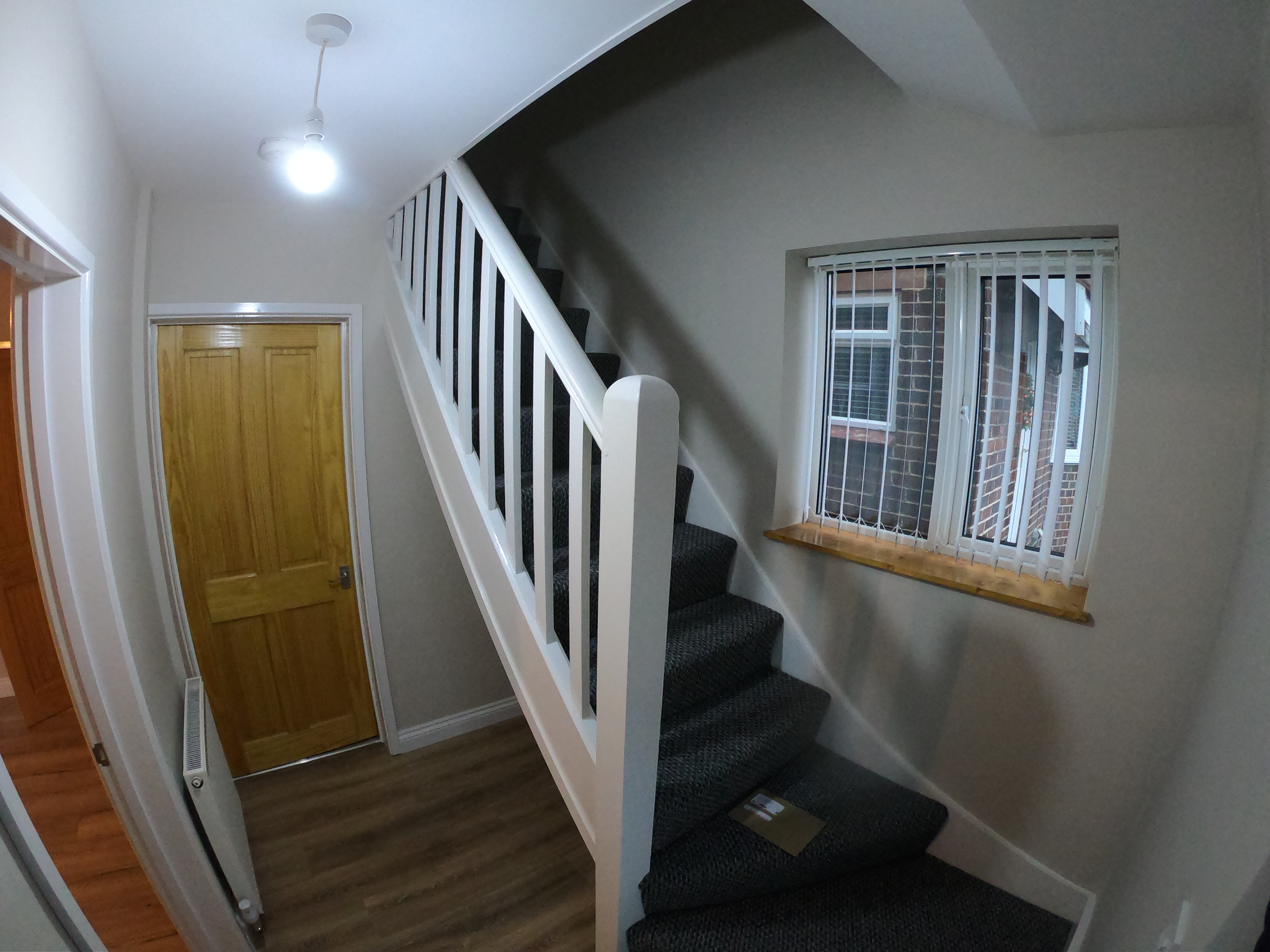
| Hallway with new doorway to downstairs cloakroom |
| Cloakroom |
| Master bedroom |
| 2nd bedroom |
| Upstairs bathroom |
New van conversion complete
The van was finished early in 2016.
We spent heaps on it... but if you're going to use it it's worth it!
It's been to the Lakes, Dartmoor, Exmoor, Beacons, Alps etc etc.
It certainly is a more economical version than the old T5. One trip up the Lakes at 70mph on the motorway saw it average 43 mpg. But it's not as 'pokey' as the 5 cylinder engine in the old one. The 'bluemotion' mapping means it's harder to accelerate from a stop, but the 140bhp gets it up the hills well. Being newer, its much smoother and quieter generally.
Cruise control and air con is essential on those long journeys.
In this version we have a back cooker and sink accessible from under the rear tailgate.
We have the same 2x single bed configuration with front seats on a turntable.
Table goes up on drivers side
SCA pop-top gives good headroom when parked up...
And a double bed upstairs
And we decided on a compressor fridge that runs off the leisure battery.
Love it. Why doesn't everyone have one?
Wednesday, 9 December 2015
More van
Floor is 9mm plywood. To avoid having to drill and screw directly into the metal floor we've Sikafixed 9mm battens to the flat parts of the floor (which are conveniently 9mm below the ridged sections).
All cables for fridge, lights, lesiure battery, heater, etc run between the ridges
Insulation then on top of the that, and then the floor is screwed to the battens
We start the cupboards. The lightweight 15mm 'carbon' style plywood is over £100 per sheet. Jigsaw the openings.
Use a router to cut slot in the hole edges.
It's a 2mm slot cutter
T-trim tidies up the edges
This where it will go in the van - large unfinished opening for the fridge.
The pieces you cut out become the doors. Special door trim goes all the way round.
The door fits snugly in hole .
Viewed from inside.
And outside
And so the Van
Our current VW Transporter T5 van is getting a little long in the tooth so we have recently bought a 2014 model that we are converting.
The old one has served us well as a weekender / day van. Based on 2.5 tdi 130 bhp it would cruise at 70mph at 2000 revs and deliver around 33mpg. With cruise control it was effortless to drive. We've done over 100,000 miles in it with trips to the Alps and Scotland every year.
When we converted it we put in hob, sink, auxiliary diesel heater, cupboards, rear single passenger sits that convert to beds, front swivels, leisure battery etc. The configuration meant hat we could still carry 8x4 sheets of plasterboard and 3.6m lengths of timber down the middle. The base of the rear seats were steel lockers that could be padlocked to make two large secure stores for those remote spots when you leave the van for 2-3 days trip to the mountains.
The new van will have all these plus fridge and pop-top. The pop-top will have a bed so in effect it will be 4 berth. The fridge will run from 12v leisure battery backed up with solar charger - we'll also put in an electrical hookup with battery charger and 300w inverter.
The new base van is a VW Transporter T5 2.0 tdi 140 bhp highline bluemotion (common rail engine). It comes with colour coded bumpers, tailgate, cruise control, air con, sat nav, bluetooth etc.
The old van
Seating arrangements
The hob and sink
Loads of storage
One of the beds
The old one has served us well as a weekender / day van. Based on 2.5 tdi 130 bhp it would cruise at 70mph at 2000 revs and deliver around 33mpg. With cruise control it was effortless to drive. We've done over 100,000 miles in it with trips to the Alps and Scotland every year.
When we converted it we put in hob, sink, auxiliary diesel heater, cupboards, rear single passenger sits that convert to beds, front swivels, leisure battery etc. The configuration meant hat we could still carry 8x4 sheets of plasterboard and 3.6m lengths of timber down the middle. The base of the rear seats were steel lockers that could be padlocked to make two large secure stores for those remote spots when you leave the van for 2-3 days trip to the mountains.
The new van will have all these plus fridge and pop-top. The pop-top will have a bed so in effect it will be 4 berth. The fridge will run from 12v leisure battery backed up with solar charger - we'll also put in an electrical hookup with battery charger and 300w inverter.
The new base van is a VW Transporter T5 2.0 tdi 140 bhp highline bluemotion (common rail engine). It comes with colour coded bumpers, tailgate, cruise control, air con, sat nav, bluetooth etc.
Tuesday, 8 December 2015
Heat Pump update
Let me wax lyrical about Heat Pumps - Air Source Heat Pumps (ASHP)
They are simply, quite amazing. Although I spent ages researching them, made all the calculations, spoke to lots of people about them etc, it wasn't until I found someone with one who kept all their electricity consumption figures on a spreadsheet, that I finally decided to take the plunge.
I mean. Get all your heat for your home in winter from the air outside? Crazy!
Crazy but true.
What about when it's below freezing I hear you ask - no problem.
Let's start with the figures.
Oct 2013 - Oct 2014. Cost to run £311.00.
That's all the space heating for our 3 bedroom, 3 reception room, 2 bathroom (and sun lounge) home for a whole year. Bathrooms at 20 degrees, living rooms 19 degrees and bedrooms 18 degrees.
We are getting £600 per year from the government in what are called RHI's (renewable heat incentives). These are for a period of 7 years so we get a total of £4200 in subsidies. The idea of the RHI's is to give those installing new heat systems a financial payback for the greater cost of installing heat pump systems compared to the cheaper installation cost of an oil boiler.
You can get a an efficient condensing oil boiler for around £1500. We paid £4000 for out heat pump. Labour costs of installing each would be about the same.
How do they work?
They are in effect a giant fridge. A fridge takes the heat out of the inside (thus cooling your food) and dumps it in those black coils at the rear. This is what our heat pump does - takes the heat out of the air and dumps it in the underfloor heating coils. Heat pumps work better with underfloor heating as the water in the pipes never really gets above 42 degrees. Standard domestic radiators require the water in them to be over 60 degrees. Using heat pumps with standard radiators won't work as you'll not be able to get enough heat from them to sufficiently warm your house... unless you double (at least) the size of your radiators.
Further points:
I mean. Get all your heat for your home in winter from the air outside? Crazy!
Crazy but true.
What about when it's below freezing I hear you ask - no problem.
Let's start with the figures.
Oct 2013 - Oct 2014. Cost to run £311.00.
That's all the space heating for our 3 bedroom, 3 reception room, 2 bathroom (and sun lounge) home for a whole year. Bathrooms at 20 degrees, living rooms 19 degrees and bedrooms 18 degrees.
We are getting £600 per year from the government in what are called RHI's (renewable heat incentives). These are for a period of 7 years so we get a total of £4200 in subsidies. The idea of the RHI's is to give those installing new heat systems a financial payback for the greater cost of installing heat pump systems compared to the cheaper installation cost of an oil boiler.
You can get a an efficient condensing oil boiler for around £1500. We paid £4000 for out heat pump. Labour costs of installing each would be about the same.
How do they work?
They are in effect a giant fridge. A fridge takes the heat out of the inside (thus cooling your food) and dumps it in those black coils at the rear. This is what our heat pump does - takes the heat out of the air and dumps it in the underfloor heating coils. Heat pumps work better with underfloor heating as the water in the pipes never really gets above 42 degrees. Standard domestic radiators require the water in them to be over 60 degrees. Using heat pumps with standard radiators won't work as you'll not be able to get enough heat from them to sufficiently warm your house... unless you double (at least) the size of your radiators.
Further points:
- When we renovated the house we took great care to insulate it to a high standard (as can be seen from past blog posts) . This helps the ASHP deliver enough heat to keep the house toasty.
- Underfloor heating (UFL) is a great way to heat your house - warm air gradually rises and you get less dust and convection currents - drafts. You'll have nice toasty feet too.
- UFL with hot water embedded in your screed means you will need dig out your floors to a depth of at least 300mm (having said that there are some systems that you can lay on your existing floor and only raise it be 20-30mm)
- The ASHP does make some noise but certainly no more than a standard boiler. There are some regulations about where you can place them (although local authorities do seem a little confused about the situation).
- ASHP require little maintenance and there isn't much to go wrong - a couple of electrical motors basically.
- I installed the system myself and got great support and advice by the supplying company. In order to qualify for the RHI's you need the system to be supplied, designed and commissioned by an MCof S accredited company.
Friday, 16 October 2015
House update Dec 2015
It's been a long time since I've posted here - much has happened so been very busy.
The house is complete.
Here are some photos showing the final stages
Front elevation of the crumbly part gets membrane...
And then cladding. It's now waterproof!
The old potting shed wall gets a makeover.
The pond is finished.
Great sunsets in the summer
The house with the golden windows.
The heat pump gets connected - more on this later
Porch over front door goes up.
More glowing at sunset.... and the patio and decking get laid
And finally the paving
Subscribe to:
Posts (Atom)